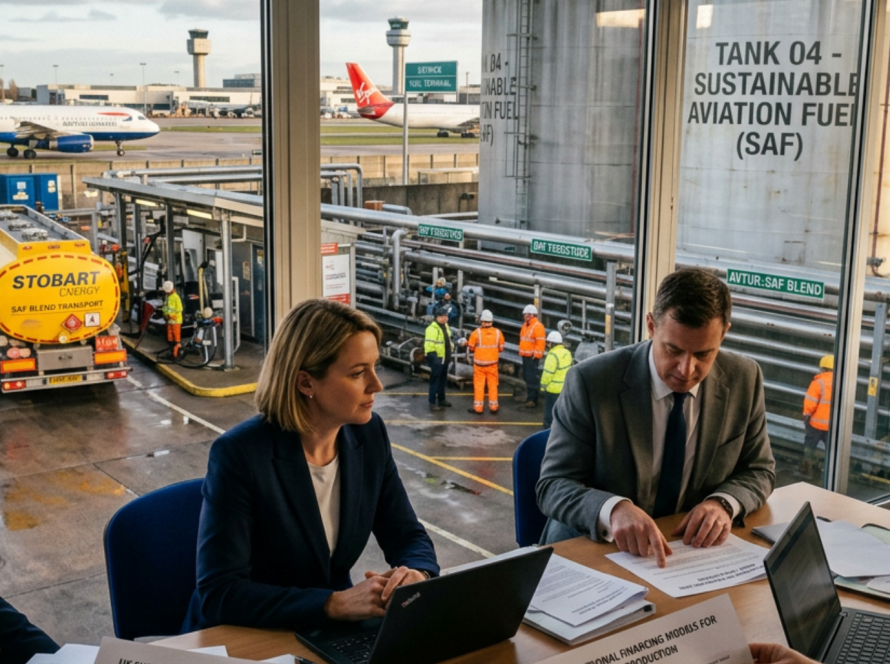

Sustainable aviation fuel (SAF) has moved decisively from pilot programs to boardroom priority. What was once viewed as an experimental decarbonization lever is now emerging as the aviation sector’s most credible pathway to meet tightening climate mandates-without grounding growth.
According to the Sustainable Aviation Fuel Market Report 2026, the global SAF market is set to expand from $3.7 billion in 2025 to $5.75 billion in 2026, before accelerating to $26.1 billion by 2030. This trajectory signals more than rapid adoption-it reflects a structural shift in how aviation, energy, and fuel supply chains are being rebuilt.
For airline executives, fuel producers, and investors, SAF is no longer a sustainability narrative. It is a strategic fuel transition.
Regulation and Airline Commitments Are Converging
The market’s momentum is being driven by a rare alignment of forces:
- Regulatory pressure to curb aviation emissions across the U.S., EU, and Asia
- Mandatory SAF blending targets emerging in multiple jurisdictions
- Long-term airline offtake agreements securing future fuel supply
- Public and private capital flowing into production and infrastructure
Aviation faces limited alternatives to liquid fuels at scale. As a result, SAF has become the only near-term solution capable of materially reducing emissions without disrupting global air travel.
Scaling Production Is the Central Opportunity
The next phase of growth hinges on scale.
Large-format SAF facilities, advanced bio-refineries, and diversified feedstock strategies-ranging from agricultural waste to algae-based inputs-are now central to investment decisions. Artificial intelligence is increasingly being deployed to optimize conversion efficiency, reduce costs, and improve yield predictability.
Equally important is the buildout of blending, storage, and airport distribution infrastructure, which is emerging as a competitive differentiator across regions.
North America currently leads SAF deployment, but the Middle East and Asia-Pacific are expected to post the fastest growth as national carriers and energy producers move aggressively to secure future supply.
Read More : Thailand SAF mandate driving sustainable aviation fuel adoption from 2026
Competitive Landscape: Energy Majors and New Entrants Converge
The SAF ecosystem is expanding rapidly, with traditional energy leaders such as Shell, BP, TotalEnergies, and Neste scaling production alongside specialized innovators like LanzaTech, LanzaJet, Gevo, and Fulcrum BioEnergy.
Strategic consolidation is also reshaping the market. Airlines are increasingly moving upstream to secure feedstock and technology access, recognizing SAF as both a cost risk and a reputational asset.
For executives, this signals a transition from spot purchasing to long-term, vertically integrated fuel strategies.
Trade Frictions and Localization Pressures
Global tariffs on biofuel feedstocks and refining equipment remain a challenge, adding cost and complexity. However, these pressures are also accelerating regional SAF ecosystems, encouraging localized production and more resilient supply chains.
In effect, SAF is becoming not just a climate solution-but a geopolitical and industrial policy instrument.
Executive Takeaway
The sustainable aviation fuel market has entered its execution phase.
By 2030, SAF will define competitive advantage in aviation-not only in emissions performance, but in fuel security, regulatory compliance, and cost control. Companies that move early to secure supply, invest in scalable technologies, and integrate SAF into long-term planning will be better positioned to navigate a carbon-constrained future.